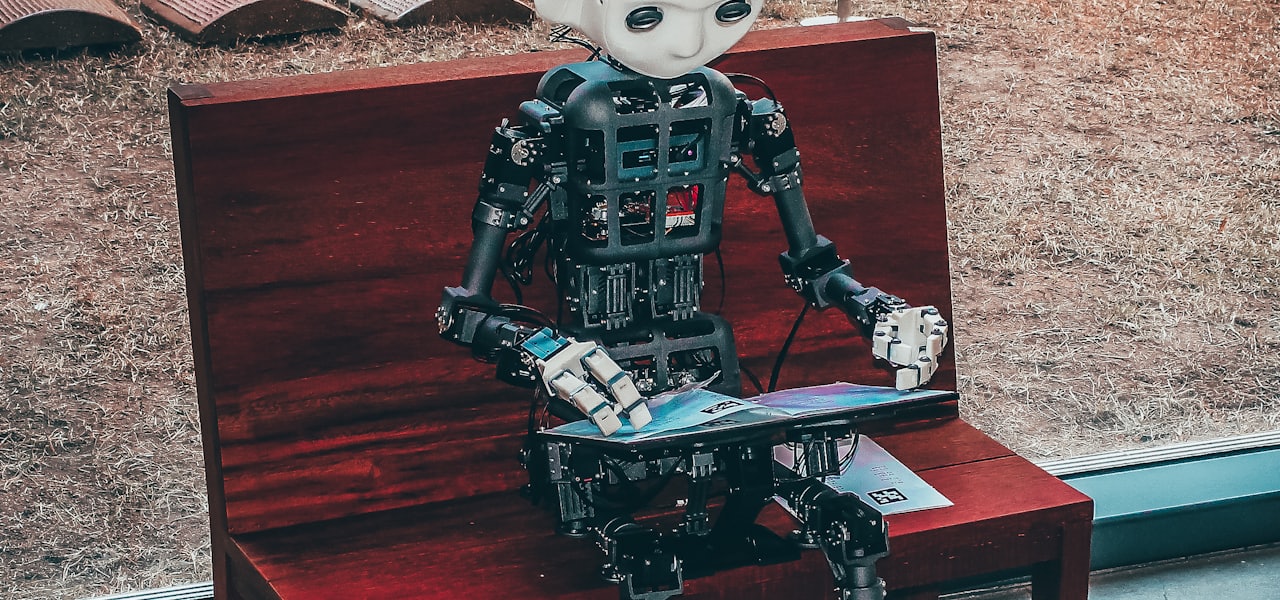
In computer science, an evolving intelligent system is a fuzzy logic system which improves the own performance by evolving rules. The technique is known from machine learning, in which external patterns are learned by an algorithm. Fuzzy logic based machine learning works with neuro-fuzzy systems. Intelligent systems have to be able to evolve, self-develop, and self-learn continuously in order to reflect a dynamically evolving environment. The concept of Evolving Intelligent Systems (EISs) was conceived around the turn of the century with the phrase EIS itself coined for the first time by Angelov and Kasabov in a 2006 IEEE newsletter and expanded in a 2010 text. EISs develop their structure, functionality and internal knowledge representation through autonomous learning from data streams generated by the possibly unknown environment and from the system self-monitoring. EISs consider a gradual development of the underlying (fuzzy or neuro-fuzzy) system structure and differ from evolutionary and genetic algorithms which consider such phenomena as chromosomes crossover, mutation, selection and reproduction, parents and off-springs. The evolutionary fuzzy and neuro systems are sometimes also called "evolving" which leads to some confusion. This was more typical for the first works on this topic in the late 1990s. == Implementations == EISs can be implemented, for example, using neural networks or fuzzy rule-based models. The first neural networks which consider an evolving structure were published in. These were later expanded by N. Kasabov and P. Angelov for the neuro-fuzzy models. P. Angelov introduced the evolving fuzzy rule-based systems (EFSs) as the first mathematical self-learning model that can dynamically evolve its internal structure and is human interpretable and coined the phrase EFS. Contemporarily, the offline incremental approach for learning an EIS, namely, EFuNN, was proposed by N. Kasabov. P. Angelov, D. Filev, N. Kasabov and O. Cordon organised the first IEEE Symposium on EFSs in 2006 (the proceedings of the conference can be found in). EFSs include a formal (and mathematically sound) learning mechanism to extract it from streaming data. One of the earliest and the most widely cited comprehensive survey on EFSs was done in 2008. Later comprehensive surveys on EFS methods with real applications were done in 2011 and 2016 by E. Lughofer. Other works that contributed further to this area in the following years expanded it to evolving participatory learning, evolving grammar, evolving decision trees, evolving human behaviour modelling, self-calibrating (evolving) sensors (eSensors), evolving fuzzy rule-based classifiers, evolving fuzzy controllers, autonomous fault detectors. More recently, the stability of the evolving fuzzy rule-based systems that consist of the structure learning and the fuzzily weighted recursive least square parameter update method has been proven by Rong. Generalized EFS, which allow rules to be arbitrarily rotated in the feature space and thus to improve their data representability, have been proposed in with significant extensions in towards 'smartness' of the rule bases (thus, termed as "Generalized Smart EFS"), allowing more interpretability and reducing curse of dimensionality. The generalized rule structure was also successfully used in the context of evolving neuro-fuzzy systems. Several facets and challenges for achieving more transparent and understandable rule bases in EFS have been discussed by E. Lughofer in. EISs form the theoretical and methodological basis for the Autonomous Learning Machines (ALMA) and autonomous multi-model systems (ALMMo) as well as of the Autonomous Learning Systems. Evolving Fuzzy Rule-based classifiers, in particular, is a very powerful new concept that offers much more than simply incremental or online classifiers – it can cope with new classes being added or existing classes being merged. This is much more than just adapting to new data samples being added or classification surfaces being evolved. Fuzzy rule-based classifiers are the methodological basis of a new approach to deep learning that was until now considered as a form of multi-layered neural networks. Deep Learning offers high precision levels surpassing the level of human ability and grabbed the imagination of the researchers, industry and the wider public. However, it has a number of intrinsic constraints and limitations. These include: The "black box", opaque internal structure which has millions of parameters and involves ad hoc decisions on the number of layers and algorithm parameters. The requirement for a huge amount of training data samples, computational resources (usually requiring GPUs and/or HPC) and time (usually requiring many hours of training). Iterative search. Requires retraining for new situations (is not evolving). Does not have proven convergence and stability. Most, if not all, of the above limitations can be avoided with the use of the Deep (Fuzzy) Rule-based Classifiers, which were recently introduced based on ALMMo, while achieving similar or even better performance. The resulting prototype-based IF...THEN...models are fully interpretable and dynamically evolving (they can adapt quickly and automatically to new data patterns or even new classes). They are non-parametric and, therefore, their training is non-iterative and fast (it can take few milliseconds per data sample/image on a normal laptop which contrasts with the multiple hours the current deep learning methods require for training even when they use GPUs and HPC). Moreover, they can be trained incrementally, online, or in real-time. Another aspect of Evolving Fuzzy Rule-based classifiers has been proposed in, which, in case of multi-class classification problems, achieves the reduction of class imbalance by cascadability into class sub-spaces and an increased flexibility and performance for adding new classes on the fly from streaming samples.
Co–Star
Co–Star is an American astrological social networking service founded in 2017, and headquartered in New York City. Users enter the date, time and place they were born to generate an astrological chart and daily horoscopes, which can be compared with those of other users. == History == The concept for Co-Star began in 2015 when Banu Guler created an astrological chart as a gift. The idea later developed into a mobile application with collaborators Anna Kopp and Ben Weitzman. The app publicly launched in 2017. The app includes astrological readings, charts, and daily push notifications that have been noted for their unconventional tone. In early 2018, the company raised a $750,000 pre-seed round from Female Founders Fund. In 2019, Co–Star raised a $5.2 million seed round from Maveron, Aspect, and 14W. In January 2020, Co–Star for Android was launched to a 120,000-person waitlist—two years after their iOS version. In April 2021, the company announced a $15 million Series A, led by Spark Capital. As of that date, Co–Star reported more than 20 million downloads and increased adoption among young women in the United States. == Features == Co–Star employs artificial intelligence to analyze publicly accessible NASA JPL data and find patterns in a user's transits. Co–Star's algorithm maps human-written snippets of text to planetary movements to display personalized content for each user. That content has been called “slightly robotic,” “wildly beautiful,” “truly insane," “brutally honest,” and compared to “a free therapy session.” In July 2023, Co–Star released an in-app service called The Void that allows users to ask open-ended questions and receive answers informed by Co–Star's astrological database.
Symmetric Boolean function
In mathematics, a symmetric Boolean function is a Boolean function whose value does not depend on the order of its input bits, i.e., it depends only on the number of ones (or zeros) in the input. For this reason they are also known as Boolean counting functions. There are 2n+1 symmetric n-ary Boolean functions. Instead of the truth table, traditionally used to represent Boolean functions, one may use a more compact representation for an n-variable symmetric Boolean function: the (n + 1)-vector, whose i-th entry (i = 0, ..., n) is the value of the function on an input vector with i ones. Mathematically, the symmetric Boolean functions correspond one-to-one with the functions that map n+1 elements to two elements, f : { 0 , 1 , . . . , n } → { 0 , 1 } {\displaystyle f:\{0,1,...,n\}\rightarrow \{0,1\}} . Symmetric Boolean functions are used to classify Boolean satisfiability problems. == Special cases == A number of special cases are recognized: Majority function: their value is 1 on input vectors with more than n/2 ones Threshold functions: their value is 1 on input vectors with k or more ones for a fixed k All-equal and not-all-equal function: their values is 1 when the inputs do (not) all have the same value Exact-count functions: their value is 1 on input vectors with k ones for a fixed k One-hot or 1-in-n function: their value is 1 on input vectors with exactly one one One-cold function: their value is 1 on input vectors with exactly one zero Congruence functions: their value is 1 on input vectors with the number of ones congruent to k mod m for fixed k, m Parity function: their value is 1 if the input vector has odd number of ones The n-ary versions of AND, OR, XOR, NAND, NOR and XNOR are also symmetric Boolean functions. == Properties == In the following, f k {\displaystyle f_{k}} denotes the value of the function f : { 0 , 1 } n → { 0 , 1 } {\displaystyle f:\{0,1\}^{n}\rightarrow \{0,1\}} when applied to an input vector of weight k {\displaystyle k} . === Weight === The weight of the function can be calculated from its value vector: | f | = ∑ k = 0 n ( n k ) f k {\displaystyle |f|=\sum _{k=0}^{n}{\binom {n}{k}}f_{k}} === Algebraic normal form === The algebraic normal form either contains all monomials of certain order m {\displaystyle m} , or none of them; i.e. the Möbius transform f ^ {\displaystyle {\hat {f}}} of the function is also a symmetric function. It can thus also be described by a simple (n+1) bit vector, the ANF vector f ^ m {\displaystyle {\hat {f}}_{m}} . The ANF and value vectors are related by a Möbius relation: f ^ m = ⨁ k 2 ⊆ m 2 f k {\displaystyle {\hat {f}}_{m}=\bigoplus _{k_{2}\subseteq m_{2}}f_{k}} where k 2 ⊆ m 2 {\displaystyle k_{2}\subseteq m_{2}} denotes all the weights k whose base-2 representation is covered by the base-2 representation of m (a consequence of Lucas’ theorem). Effectively, an n-variable symmetric Boolean function corresponds to a log(n)-variable ordinary Boolean function acting on the base-2 representation of the input weight. For example, for three-variable functions: f ^ 0 = f 0 f ^ 1 = f 0 ⊕ f 1 f ^ 2 = f 0 ⊕ f 2 f ^ 3 = f 0 ⊕ f 1 ⊕ f 2 ⊕ f 3 {\displaystyle {\begin{array}{lcl}{\hat {f}}_{0}&=&f_{0}\\{\hat {f}}_{1}&=&f_{0}\oplus f_{1}\\{\hat {f}}_{2}&=&f_{0}\oplus f_{2}\\{\hat {f}}_{3}&=&f_{0}\oplus f_{1}\oplus f_{2}\oplus f_{3}\end{array}}} So the three variable majority function with value vector (0, 0, 1, 1) has ANF vector (0, 0, 1, 0), i.e.: Maj ( x , y , z ) = x y ⊕ x z ⊕ y z {\displaystyle {\text{Maj}}(x,y,z)=xy\oplus xz\oplus yz} === Unit hypercube polynomial === The coefficients of the real polynomial agreeing with the function on { 0 , 1 } n {\displaystyle \{0,1\}^{n}} are given by: f m ∗ = ∑ k = 0 m ( − 1 ) | k | + | m | ( m k ) f k {\displaystyle f_{m}^{}=\sum _{k=0}^{m}(-1)^{|k|+|m|}{\binom {m}{k}}f_{k}} For example, the three variable majority function polynomial has coefficients (0, 0, 1, -2): Maj ( x , y , z ) = ( x y + x z + y z ) − 2 ( x y z ) {\displaystyle {\text{Maj}}(x,y,z)=(xy+xz+yz)-2(xyz)} == Examples ==
Protecting Our Kids from Social Media Addiction Act
Protecting Our Kids from Social Media Addiction Act also known as California SB 976 is a law that was enacted in September 2024 that is meant to address problematic social media usage among minors. The law prohibitions minors to have "addictive feeds" unless they have verifiable parental consent, minor's notifications are also restricted between 12 am to 6 am and during school hours between 8 am and 3 pm it also well requires minors to have default privacies settings and have social media companies to publicly disclose certain metrics about their users. The law was set to take effect in two steps the first being the restrictions on social media feeds, notifications, disclosures from social media companies and default settings which would have taken effect on January 1, 2025, and the age verification provision which would have taken effect on January 1, 2027. However, has faced legal challenges since its enactment delaying its enactment. == Legal Challenges == In November 2024 NetChoice a trade association representing many of the biggest social media companies such as YouTube, Facebook and Instagram sued the attorney general of California Rob Bonta hoping to get an injunction before the first set of the law's provisions would take effect in January of the next year. However, judge Edward Davila would only grant Netchoice's request as to the restrictions on notifications and public disclosures and would deny their request as to the rest of the law. The law was later fully enjoined temporarily by the District Court and Appellant Court pending appeal, and the case is now in the Ninth Circuit Court of Appeals and is pending a decision. === Social media platforms challenges to law === In November 2025 Meta, Google and TikTok filed lawsuits against the law arguing it violates the first amendment.
Social media stock bubble
The social media bubble is a hypothesis stating that there was a speculative boom and bust phenomenon in the field of social media in the 2010s, particularly in the United States. The Wall Street Journal defined a bubble as stocks "priced above a level that can be justified by economic fundamentals," but this bubble includes social media. Social networking services (SNS) have seen huge growth since 2006, but some investors believed around 2014-2015, that the "bubble" was similar to the dot-com bubble of the late 1990s and early 2000s. In 2015, Mark Cuban, owner of the Dallas Mavericks NBA team and star of the TV show, Shark Tank, sounded an alarm on his personal blog over the social media bubble, calling it worse than the tech bubble in 2000 due to the lack of liquidity in social media stocks. A year prior, however, Cuban told CNBC that he did not believe social media stocks were on the verge of a bubble. In a letter to investors in 2014, David Einhorn, who runs the hedge-fund Greenlight Capital, wrote that "we are witnessing our second tech bubble in 15 years." He went on to write, "What is uncertain is how much further the bubble can expand, and what might pop it." Einhorn cited several factors supporting the existence an over-exuberance including "rejection of conventional valuation methods" and "huge first day IPO pops for companies that have done little more than use the right buzzwords and attract the right venture capital." Since those claims, services like Facebook, Twitter, Instagram, and Snapchat have grown to become multi-billion-dollar corporations generating enormous revenues, though some continue to lose money. == History of social networking services == Social networking services have grown and evolved with time since the launch of SixDegrees.com in 1997. Cutting edge at its time, SixDegrees.com allowed users to create a profile, invite friends, and connect within its platform. At its peak, SixDegrees.com had more than 3.5 million users. Between 1997 and 2001 more social sites aimed at allowing users to connect with others for personal, professional, or dating reasons. Friendster and MySpace were next to enter the social SNS arena, followed by Facebook in 2004. Even though MySpace had a following of more than 300 million users, it could not compete with Facebook, which now has overtaken the social networking world. However, as development of SNS started to emerge, a market saturation began to take effect. Some classrooms have begun to incorporate technology in daily learning as well as social channels specific to student's course work. Traditional social media sites are used, as are educational oriented sites such as ShowMe and Educreations Interactive Whiteboard. == Controversies == While SNS continue to play an influential role in helping people form real-world connections via the Internet, renewed concerns over the social media bubble have surfaced due to recent controversies. These threats include growing concerns about breaches in data, the rise of bot accounts, and the sharing of fake news on SNS platforms. There are also concerns that big data figures associated with these SNS are inflated or fake, as well as worries about the role the platforms played in national elections (see Russian interference in the 2016 United States elections). These issues have resulted in a lack of trust among the sites' users.
Tea (app)
Tea, officially Tea Dating Advice, is a dating surveillance mobile phone application that allows women to post personal data about men they are interested in or are currently dating. Founded by Sean Cook, the app rose to prominence in July 2025 after it was the subject of three major data leaks in July and August 2025. It was removed from Apple's App Store in October 2025, but remains available on the Google Play Store. == History == The app enables its users to upload, view, and comment on photos of men, check men's public records, and perform image searches. It also provides the ability to rate and review men, as well as a group chat function. The app uses artificial intelligence to verify that the user is a woman through facial analysis and other personal information to preserve the app as a women-only space. Users are required to submit their photo and an ID to access the app. The company that created the app was founded by businessman and tech capitalist Sean Cook, who stated in July 2025 that he was inspired to create the app because of his mother's experiences from online dating. According to the company, users remain anonymous, and the requirement to upload an ID was removed in 2023. An August 2025 investigation by 404 Media suggested that much of the information given by Cook on the historical background of the company was inaccurate. In July 2025, private messages, other personally identifying information, and approximately 72,000 images were leaked via 4chan. A further 1.1 million private messages were subsequently leaked using a separate security vulnerability; these included intimate conversations about controversial topics such as adultery and other forms of infidelity to their partners, discussions of abortion, phone numbers, meeting locations, and other confidential communications. The app's publishers subsequently revoked the ability to private message users in the app. Shortly after, the app was hidden from search on Android and an interactive, unverified map was also created of those in the files. By 7 August 2025, ten class action lawsuits had been filed. A further leak was reported later that month. Proponents have praised the app as an aid for women's safety by helping them check men for adultery, catfishing, criminal convictions and other "red flag" behaviors. Critics have described the app as a doxing tool and a violation of privacy, an opportunity for defamation against innocent individuals, and a witch hunt. Cook has stated that the company's legal team receives about three legal threats per day. Another mobile app, called TeaOnHer, was created in response of the app’s popularity. It was described as the male version of the Tea app. The app also reported a data breach in August 2025. In October 2025, Apple removed the app from their app store, telling journalists that the removal was due to a failure to meet company terms regarding content moderation and user privacy. Apple also mentioned an excessive amount of complaints, including allegations that the personal information of minors was being shared. The app remains on the Google Play Store.
Social media as a public utility
Social media as a public utility is a theory postulating that social networking sites (such as Meta - ie:Facebook & Instagram or Alphabet - ie: YouTube & Google, but also independent sites such as Twitter, Tumblr, Snapchat etc.) are essential public services that should be regulated by the government, in a manner similar to how electric and phone utilities are typically government regulated. It is based on the notion that social media platforms have monopoly power and broad social influence. == Background == === Definitions === Social media is defined as "a group of Internet-based applications that build on the ideological and technological foundations of Web 2.0, and that allow the creation and exchange of User Generated Content." Furthermore, the New Zealand Government of Internal Affairs describes it as "a set of online technologies, sites, and practices which are used to share opinions, experiences and perspectives. Fundamentally it is about the conversation. In contrast with traditional media, the nature of social media is to be highly interactive." Moreover, the term social media is described as online tools that let people interact and communicate with each other. This has become a standard word for online cultural exchange and a dominant way for individuals to engage on the internet. By using social media individuals become more closely and strongly connected than ever before. The traditional definition of the term public utility is "an infrastructural necessity for the general public where the supply conditions are such that the public may not be provided with a reasonable service at reasonable prices because of monopoly in the area." Conventional public utilities include water, natural gas, and electricity. In order to secure the interests of the public, utilities are regulated. Public utilities can also be seen as natural monopolies implying that the highest degree of efficiency is accomplished under one operator in the marketplace. Public utility regulation for social media has been largely criticized because people believe it would produce undesirable and indirect effects. However, others say that truly effective government regulation would produce valuable results. Social media as a public utility is a crucial debate because utilities get regulated, so marking social media websites as utilities would require government regulation of various social media websites and platforms such as Facebook, Google, and Twitter. Applying the term public utility to social media implies that social media websites are public necessities, and, consequently, should be regulated by the government. While social media are not as essential for survival as traditional public utilities such as electricity, water, and natural gas, many people believe it has become vital for living in an interconnected world and without it, living a successful life would be difficult. Therefore, many people believe that social media has reached utility status and should be treated as a public utility. However, others believe that this is not true because social media are constantly revolutionizing and giving such platforms "utility status" would result in government regulation, which would consequently hinder innovation. Over the past decade many have debated and questioned whether or not "Internet service providers should be considered essential facilities or natural monopolies and regulated as public utilities." === Monopoly === A monopoly is defined as "a firm that is the only seller of a product or service having no close substitutes." A natural monopoly is when the entire demand within a relevant market can be satisfied at lowest cost by one firm rather than by two or more, and if such a market contains more than one firm then the firms will "quickly shake down to one through mergers or failures, or production will continue to consume more resources than necessary." In a monopoly competition is said to be short-lived, and in a natural monopoly it is said to produce inefficient results." Public utility companies can be regulated to prevent them from gaining monopolistic control. In November 2011 AT&T's proposal for merging with T-Mobile was rejected because it would have "diminished competition," and have led to the company having monopolistic power within the telephone industry. Such regulation is permitted because the telephone industry is a public utility. Similarly, Microsoft has also been prevented from taking various business actions that could result in the company gaining monopolistic power. If social media were a public utility then regulation of Google and Facebook would similarly dictate what they could and could not do. The possibility was raised in 2018 by U.S. Representative Steve King during a House Judiciary hearing on social media filtering practices. == Arguments == Advocates of this theory believe that social media websites already act like public utilities, and therefore regulation is needed. Additionally, advocates say that in the 21st century, using such websites are as necessary for communication as using traditional public utilities such as telephone, water, electricity, and natural gas are for other everyday uses. Specifically, advocates note that Google search should be treated as a public utility and needs to be regulated because it dominates the search engine market and no website can afford to ignore it. There is the position that a social media website such as Google "is a common carrier and should be regulated as such (Newman 2011)." These are reinforced by a perception that social media companies fail to properly maintain fair platforms for discourse. === Individual level === Advocates of regulating social media as a public utility believe that having an Internet presence using social media websites is imperative for individuals to adequately take part in the 21st century. Consequently, they argue that these sites are public utilities that need to be regulated to ensure that the constitutional rights of users are protected. For example, regulation may be needed to protect freedom of speech against risks such as Internet censorship and deplatforming. Social media affects people's behavior. For instance, it plays an important role in shaping its users' decisions and actions pertaining to health. This is demonstrated in a Pew Research Center research, which showed that 72 percent of American adults turned to social media for health information in 2011. Around 70 percent of people with chronic illnesses also use the platform to find cure, diagnoses, and other health answers. This development becomes a public issue as social media are likely to provide wrong medical information. Additionally, social media sites can also facilitate deleterious health behavior such as smoking, drug use, and harmful sexual behavior. === Business level === Advocates of social media as a public utility maintain that social media services dominate the Internet and are mainly owned by three or four companies that have unparalleled power to shape user interaction, and because of this power such businesses need to be regulated as public utilities. Zeynep Tufekci, University of North Carolina Chapel Hill, claims that services on the Internet such as Google, eBay, Facebook, Amazon.com, are all natural monopolies. She has stated that these services "benefit greatly from network externalities[,] which means that the more people on the service, the more useful it is for everyone," and thus it is difficult to replace the market leader. === Government level === Advocates of social media as a public utility believe that the government should impose restrictions on social media websites, such as Google, that are designed to benefit its rivals. Due to the recent substantial growth of social media websites such as Google, advocates claim that such a website "might need search neutrality regulation modeled after net neutrality regulation and that a Federal Search Commission might be needed to enforce such a regime." danah boyd expresses a future issue which the government may have to deal with in her research: Facebook is becoming an international social media website, specifically prevalent in Canada and Europe which are "two regions that love to regulate their utilities." Furthermore, recent books by New America Foundation Senior Fellow Rebecca MacKinnon and law professor Lori Andrews advise society to start considering Facebook and Google as nation-states or the "sovereigns of cyberspace." Overall, advocates of social media as a public utility believe that due to the immense popularity and necessity of social media websites, it is imperative that the Government imposes regulations in the same manner they do for electricity, water, and natural gas. == Counterarguments == Opponents of this theory say that social media websites should not be treated as public utilities because these platforms are changing every year, and because they are not essential services for s